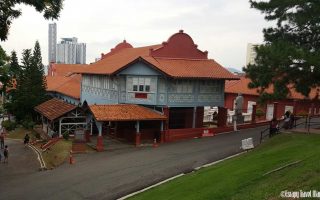
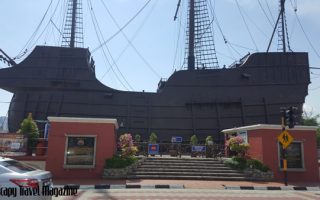
A section that once made up the old Portuguese Fort, A’Famosa.
There are cities that become famous because they are beautiful. There are cities that become famous because they are wealthy. There are cities that become famous because of something significant that happened a long time ago, and this is where Melaka belongs.
To me, Melaka is not just any city you simply stroll through. It is a place that grabs you by the collar, drags you into its story, and leaves you wondering how on earth one patch of earth could have mattered so much. It is a city so important that kings, merchants, admirals and empires crossed oceans to possess it.
Stand on the banks of the Melaka River today with a cup of iced coffee, while murals beam back at you, and then try to picture the same spot five centuries ago. The air would have been thick with the smell of spices, sweat, and ambition. Ships from every corner of the known world jostled for space, their crews shouting in a dozen languages, each convinced that fortune lay just beyond the tide.
Back then, the river was the city’s lifeline. The sea reached much closer to what is now the historic centre, and ships from China, Java, India, Arabia, Persia, the Malay world and beyond crowded the harbour. Melaka was one of the busiest trading ports in maritime Asia. It was where languages mixed, religions met, fortunes were made and news from across the Indian Ocean travelled with the monsoon winds.
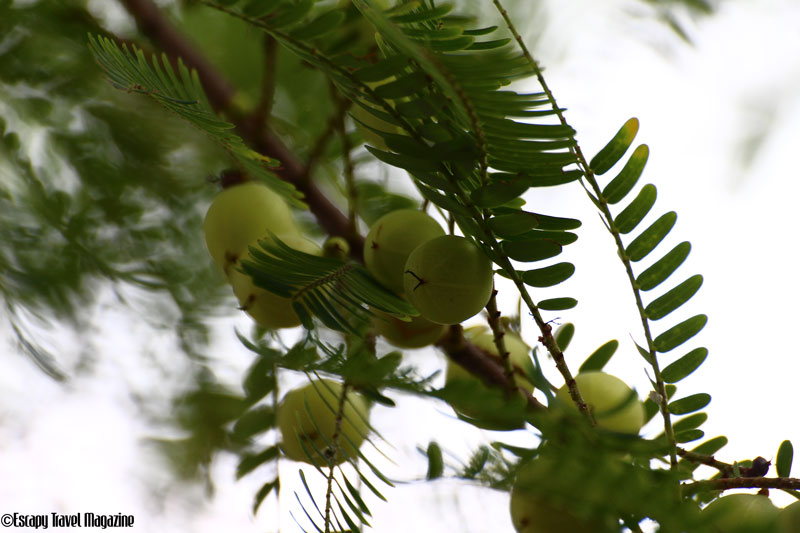
The Malacca tree (Phyllanthus emblica) with its fruits. It is from this tree that Melaka got its name.
How Melaka rose from a small settlement into a powerful sultanate remains a subject of historical study. Traditional Malay sources, such as the Sejarah Melayu (Malay Annals), describe the founding of Melaka by Parameswara, while Portuguese and Chinese records provide additional perspectives. Historians compare these sources because each was written for different audiences and with different purposes. Yet together, they help us build a richer picture, even if some details remain debated.
By the beginning of the sixteenth century, Melaka had become one of the world’s great ports. To merchants, it was an opportunity to trade, and build fortunes. To sailors, it was a destination those who have been to, share stories so marvellous, that many cats lost all nine of their lives from over curiosity. To rulers, it was a very important prize that allowed them to conquer more land. One Portuguese commander understood this better than most.
Afonso de Albuquerque did not see Melaka as merely another city to capture. His surviving correspondence and the Commentaries, later compiled by his son Brás de Albuquerque from letters and official documents, show a commander who recognised the strategic importance of controlling key maritime gateways.
Goa, Hormuz and Melaka formed part of a larger vision to secure the sea routes linking Europe, the Middle East, India, and Southeast Asia. Like all historical sources, the Commentaries are invaluable but should be read critically, as they also reflect the desire to preserve Albuquerque’s reputation.
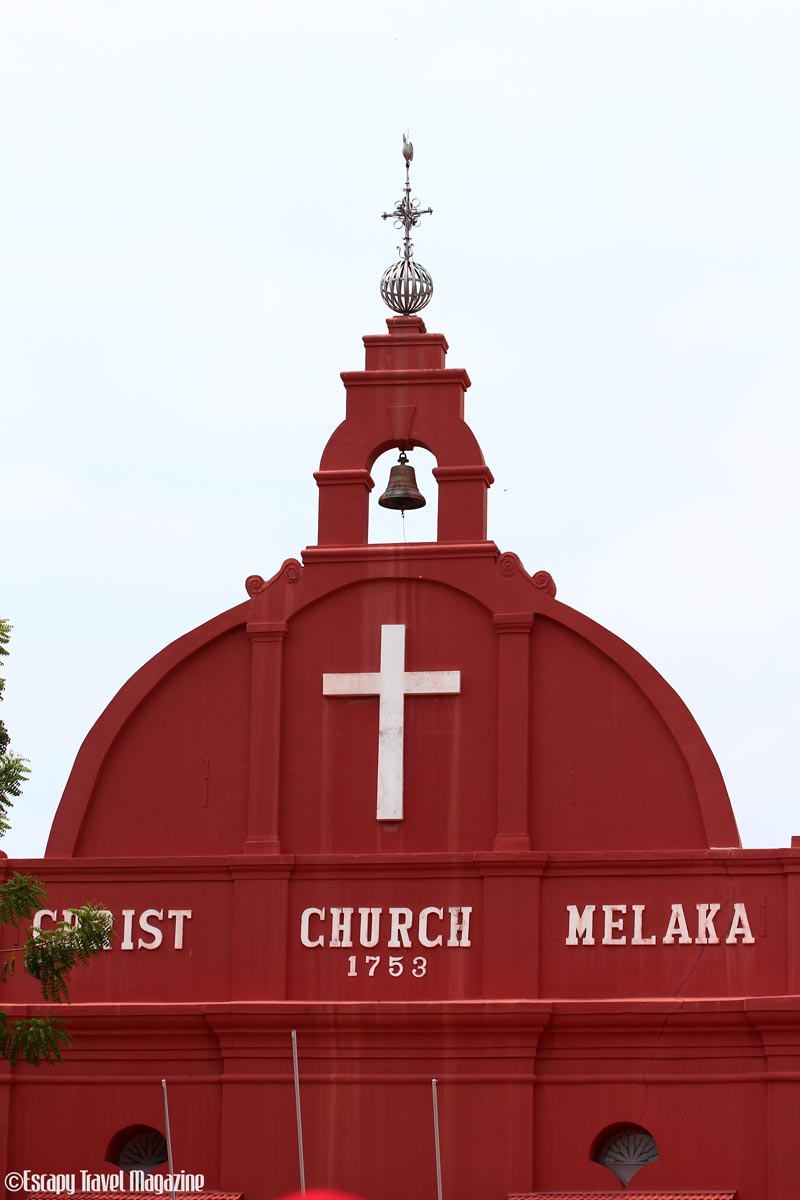
Christ Church in Malacca is one of the city’s oldest church after St Paul’s (up on St. Paul’s Hill).
In August 1511, Portuguese forces captured Melaka after fierce fighting. For the people living in the city, it was a moment of profound change. Governments changed, trade patterns shifted, and communities adapted, resisted or moved elsewhere. The conquest was neither a simple tale of triumph nor one of unrelieved destruction. It marked the beginning of a new chapter that reshaped the history of Southeast Asia.
Soon after the conquest, the Portuguese began constructing a fortress that would later become famously known as A Famosa.
Even here, history invites caution. Modern visitors often assume that “A Famosa” always referred to the entire fortress. Some historical evidence suggests the name may originally have referred to the principal tower before becoming associated with the wider fortification. It is a reminder that even familiar names deserve investigation.
Over the following centuries, Melaka passed from Portuguese to Dutch control in 1641, and later into British hands. Each administration altered the city. Buildings were adapted. Some walls were demolished, and some were rebuilt. Streets changed depending on the needs of the time.
Finally, in the early nineteenth century, most of the great Portuguese fortress was demolished by the British. Only the gate now known as Porta de Santiago survived after intervention by Sir Stamford Raffles.
The Melaka we walk through today is therefore not a frozen city from 1511. It is a city shaped by centuries of rebuilding. Land reclamation has pushed the shoreline far beyond where the sea once reached. Roads now cross areas that were once waterfront.
Standing at Porta de Santiago today requires an act of historical imagination. To understand why the fortress stood where it did, we must mentally bring the sea back to its sixteenth-century position.
That is perhaps the greatest lesson Melaka offers. History is rarely as simple as a plaque beside a monument. It is found by comparing chronicles with archaeology, old maps with modern landscapes, local traditions with documentary evidence, and by having the humility to admit when the evidence is incomplete.
Melaka does not reveal all its secrets at once. It rewards those who are willing to ask one more question, read one more source, climb one more hill and look just a little closer. Because the story of Melaka is not only about a city. It is about how trade connected continents, how empires rose and fell, how cultures met, and how the search for truth can be every bit as exciting as the search for treasure.
*With these in mind, we at Escapy Travel Magazine will soon be launching a segment that Dives Deeper into history.
Getting To Malacca
Kuala Lumpur to Malacca
By road: 180km from Kuala Lumpur City Centre
Singapore to Malacca
By road: 257km from Singapore (Changi Airport). Coaches are available from Changi Airport.
By flight: One could flight to KLIA (Kuala Lumpur International Airport) and take a bus to Malacca
Note: Although Malacca has an international airport and a train station (38 km away from Malacca city), if you are in Kuala Lumpur it is recommended to go to Malacca from Kuala Lumpur by road.
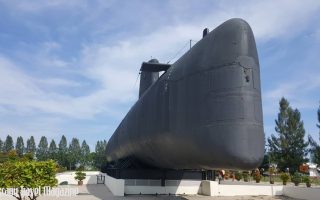
Malacca used to be a very important maritime hub and thus maritime museums are a must visit. The Submarine Museum in Malacca gives one the opportunity to see what the inside of an old submarine looks and feels like.
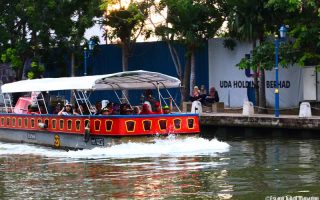
A cruise on the Melaka River is a relaxing experience. Melaka River snakes through a part of Malacca’s historical city making it a relaxing way to enjoy the sights.
Directed by Wang Chaoge, the more well known for the opening ceremony of the 2008 Olympic Games in Beijing (co-director); Encore Melaka tells a story about Malacca and its history as well as a story of its people.