“A’Famosa” Pronounced “A Fa Mo Sa”, with the first syllable sounding like “Ah”. It means “The Famous” in Portuguese. A grand fortress built after the Portuguese commander Alfonso de Albuquerque (or rather Affonso or Afonso de Albuquerque, how his name was spelt back then) captured Melaka in 1511. Simple enough… Or is it?
Today, this structure fondly called A’Famosa comes with more questions, instead of just the history we’ve been told for decades. Historians have started questioning the historical narratives that have been shared in classrooms, and by travel guides for many years. Literature from way back then, written by people back in the 1500s tell a different story.
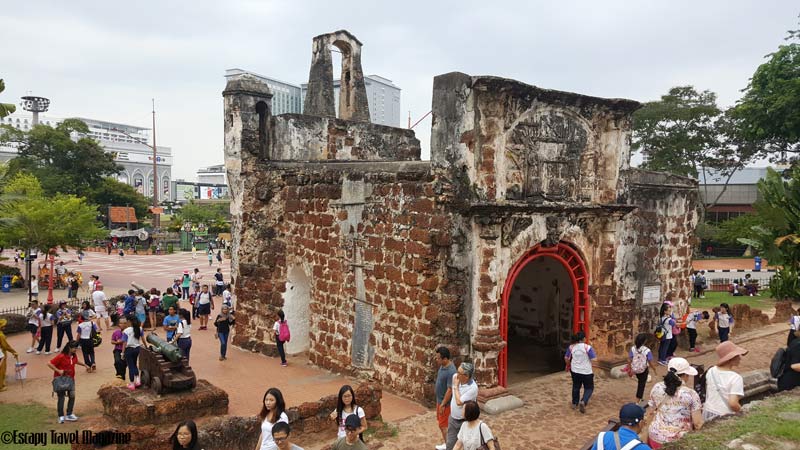
Anyway, let us first start with the stories currently being told. This structure is what’s left of the old Portuguese fort called A’Famosa. When one visits A’Famosa what one really sees is what’s left of the old grand fort; a gate house called the Porta de Santiago (the Bastion of Santiago).
Behind the Porta de Santiago used to be grounds of the fort. The fort also known as Fortaleza de la Malacca (Fortress of Malacca) covers a huge area of which used to be within the safety of a wall built of sandstones from a nearby island, called Upeh Island. Within the walls of the fort stood towers, a town with houses, ammunition stores, and the residence of the captain and officers, etc.
A’Famosa no more… This gate, what’s left of a great fort built by the Portuguese, has since been called Porta de Santiago.
Porta de Santiago is in itself a significant structure of historical greatness nonetheless. It is said to be the only surviving European fortress “gate” from the 16th century outside Europe. Think about this for a while… This here is the only surviving European fortress “gate” from the 16th century, outside of Europe. Significant indeed.
This lonely gateway standing today is only a tiny fragment of what was once called Fortaleza de Malacca. Imagine enormous sandstone walls stretching across the hill, quarried from nearby Upeh Island. Imagine soldiers patrolling towers, cannons watching the sea, officers planning battles, families living inside homes, blacksmiths hammering metal, priests praying, merchants bargaining, and storehouses packed with gunpowder that everyone hoped would never catch fire for obvious reasons involving loud noises and unexpected flying.
This place was not simply a fort. It was a living city behind stone walls. Every footstep echoed with ambition, fear, hope and survival. Then history said “enough,” and decided to change its costume…
The Dutch Era
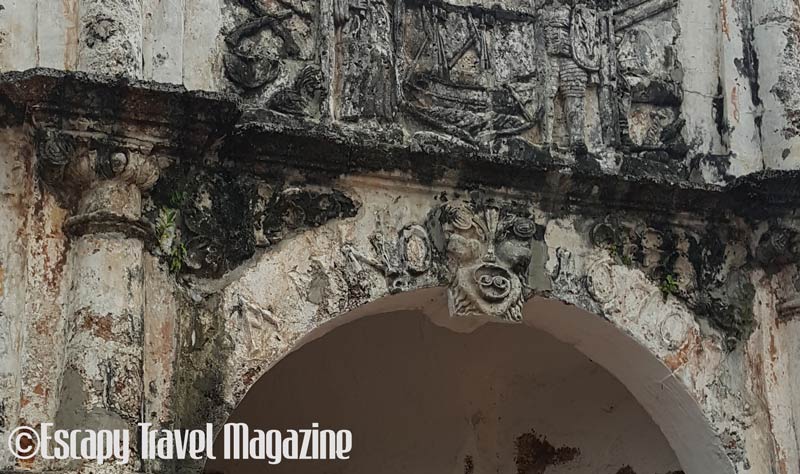
Before you walk through the famous Porta de Santiago today, pause for a moment. Look carefully at the stone above the arch. There, carved into the rock as confidently as a wizard signing his name on an ancient spell book, are the words “ANNO 1670” and the emblem of the Dutch East India Company, the VOC or Verenigde Oostindische Compagnie.
That little carving whispers a secret that many visitors never notice. The Portuguese may have built A’Famosa. But the Dutch rewrote it.
The words ANNO 1670 and the logo of the Dutch East India Company above it.
In 1641, the Dutch East India Company (Verenigde Oostindische Compagnie) joined forces with the warriors of Johor. Together they defeated the Portuguese and claimed Melaka. Disease, starvation and relentless bombardment had exhausted the defenders. Governor Manuel de Sousa Coutinho died during the siege, and according to Dutch accounts, was buried with military honours by his former enemies.
Nearly two centuries followed beneath Dutch rule. In 1670 they rebuilt the famous gateway and placed upon it their unmistakable VOC coat of arms emblem together with the words ANNO 1670. That emblem still watches every visitor today with quiet patients. Almost as though it knows something, but is not prepared to share what it knows. So, what does it know?
The Giant Tower Vanished
Here is another mystery… The original Portuguese built a five-storey keep or tower, called a Donjon. During that time, that tower was the tallest structure in the area. Here is where the circuit in your brains may fry a little. This enormous central tower is what was actually called “A Famosa.”
Surprise, surprise. This certainly surprises many people because today’s surviving gate is often called A’Famosa. But, technically, it is not. Yes, A’Famosa is actually the name of a tower, a tower no longer seen. It disappeared during or after the Dutch conquest. So again, originally, A Famosa referred to the towering keep itself, and not the entire fort.
Stones from Upeh Island made up most of the fort’s walls.
Over the centuries, the famous name migrated from the vanished tower to the gate that remained. The surviving gateway we have for so many years called A’Famosa, was simply called the Old Gateway. How we now call this old gateway Porta de Santiago is another story, one that stems from literature written back in the day such as one by Manuel Godinho de Eredia, a cartographer of mixed Bugis and Portuguese descent.
Dutch Engineers Went to Work
The Dutch were practical. Very practical in fact. If a wall was too weak, strengthen it. If a cannon position was poor, rebuild it. If a river approach looked vulnerable, construct another bastion. And this is how we get one of their finest additions, the Middelburg Bastion, completed around 1660 near the mouth of the Melaka River. It strengthened the fortress against attack from sea and river traffic.
Today visitors can see a reconstructed version after archaeologists rediscovered its foundations during construction work in 2006. That is the beauty of history. Sometimes history does not simply disappear. It waits patiently underneath a parking lot, and “boom” a part of an ancient fort appears.
The back section of Porta de Santiago.
A New Capital Appeared
Curiously, the Dutch did not continue using the Portuguese administrative heart on St Paul’s Hill in quite the same way. No. Instead, they gradually shifted the centre of administration downhill. The magnificent Stadthuys rose during the 1650s. Then came Christ Church, the oldest surviving and functioning Protestant church in Malaysia. The Dutch square slowly became the new political heart of Melaka.
Within the walls of Porta de Santiago.
The Irony of the British
Here comes the twist worthy of any magical mystery. If forts could scream, A’Famosa would probably have been heard all the way to Sumatra. Not when the Portuguese conquered Melaka. Not when the Dutch captured it after a siege that lasted months. No. Its loudest cry came in 1807, when its new British masters calmly decided that one of the greatest fortresses in Asia had become an inconvenience.
The Portuguese built A’Famosa. The Dutch improved and expanded it. Then the British blew most of it into pieces. Not because they hated Portuguese architecture. And not because they disliked Dutch engineering. But because they feared Napoleon’s expanding influence and did not want such a formidable fortress falling into enemy hands.
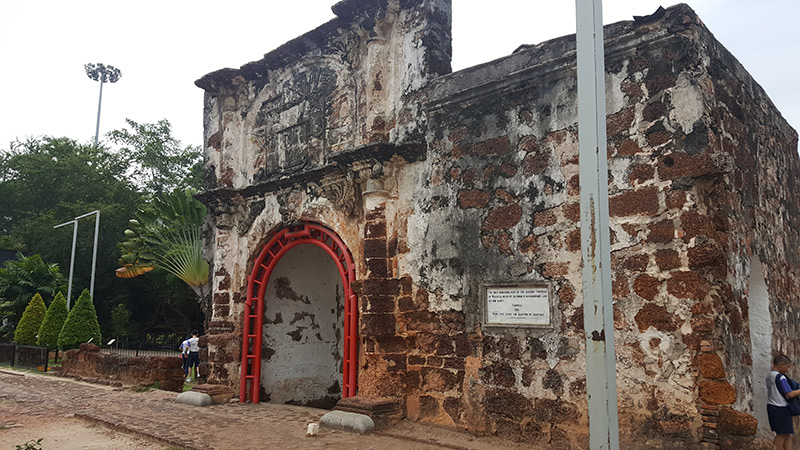
Porta de Santiago from another angle.
The British occupied Melaka in 1795 after the Netherlands fell under French control during the Napoleonic Wars. Under the Kew Letters, the Dutch instructed their overseas colonies to surrender temporarily to Britain rather than let them fall into French hands. Melaka was never intended to become Britain’s great prize.
To British eyes, Penang offered greater commercial promise. Later, Singapore would eclipse them both. Melaka was simply just there, a magnificent old fortress occupying valuable land. An expensive fortress requiring soldiers, repairs and money. Also the fear of Napolean’s army taking control of the fortress.
Military planners reached a startling conclusion to demolish the fort, the historical equivalent of throwing away a priceless enchanted sword because polishing it cost too much, and the worry of it falling into the hands of the enemy. The order was given, and Captain William Farquhar, then Resident of Melaka, supervised the work. Day after day, explosions shattered walls that had resisted cannon fire for centuries. It was the intervention of Stamford Raffles that helped save Porta de Santiago from complete destruction.
John Crawfurd a Scottish physician, colonial administrator, diplomat, and orientalist, later described how enormous sections of the fortifications disappeared under systematic demolition, leaving only fragments of what had once dominated Southeast Asia.
Very unlikely that this is a canon used during the war, but canons are nice. Here’s a few by the gate or porto.
Now, Is That All There Is Left?
Three European empires. One fortress. Three very different ideas about what should survive. And here is where the story begins to wrinkle like an old treasure map left out in the rain.
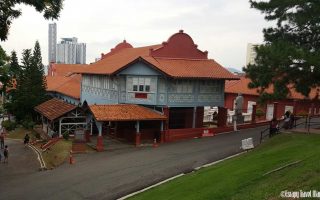
These days we hear people calling this gateway Porta de Santiago, with many still calling it A’Famosa. The we point toward Bastion Victoria (originally named St Domingo by the Portuguese). We mention Bastion Middle Burg, located at the mouth of the Malacca River (in front of the Church of St Francis Xavier). We identify Bastion Santiago, located across the road from Bastion House (Malay and Islamic World Museum). Those names appear in guidebooks, brochures and cheerful holiday websites. And I have questions…
What else are we missing?
What else are hiding right beneath our noses?
How much of the original fortress remains buried beneath our feet?
Who are the people who have played a part from where it started, till what it is today?
How accurate are the information that we read about?
Were later historians reconstructing forgotten geography using incomplete records?
Or did modern administrators simply choose to accept what seemed logical after centuries of destruction and rebuilding?
And perhaps the biggest question of all… If the names we confidently use today are not entirely accurate, then what else have we accepted as history simply because it has been repeated often enough?
Red steel beams are used to reinforce the structure of Porto de Santiago.
You see, history has an inconvenient habit of becoming tidier every time someone writes a guidebook. But, real history is rarely tidy. Cities grow, buildings disappear, maps contradict each other, and languages change. Empires too tend to rewrite yesterday’s victories while quietly erasing someone else’s memories.
A tower that once dominated the skyline slowly becomes scattered stones hidden beneath roads, museums, churches and modern buildings. Layer upon layer of history settles like pages in an ancient spell-book, each generation adding another chapter while accidentally tearing out a few before it.
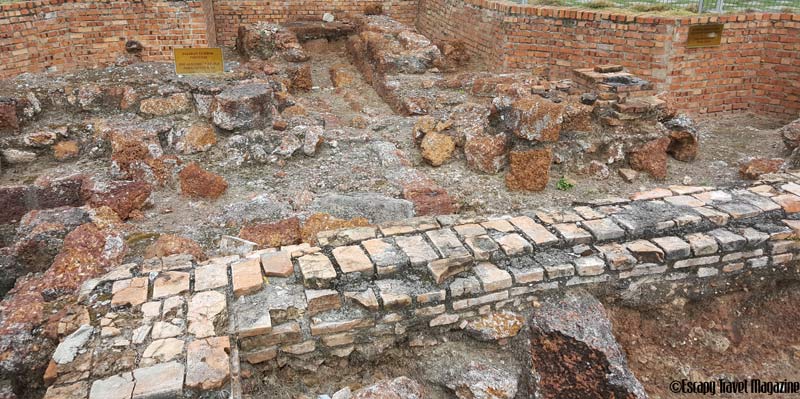
Parts of the fort that is located nearer the Melaka River.
Don’t just visit… Go Deeper and Investigate
Today, visitors gather around the Porta de Santiago with cameras clicking, while children race past the ancient stones, and tour guides enthusiastically point at weathered bricks while explaining that this was once one of the greatest fortresses in Southeast Asia.
Well, the photographs are lovely. The stories are captivating, interesting, and comfortable to tell, because we have been reading them, and sharing these bits of information for so many years. Yet, comfort has an annoying habit of hiding mysteries, and factual history.
The stones are still there. The wind still whispers through them. The records are waiting. And somewhere between forgotten maps, faded journals, overlooked archaeology, changing landscapes, and centuries of assumptions may lie a very different story about A’Famosa. Maybe it is finally time we stopped taking its story for granted… and start asking whether we have been getting its story right all along.
*Escapy Travel Magazine will soon embark on a journey that explores deeper into the history of places with a new segment called, History Deep Dive.
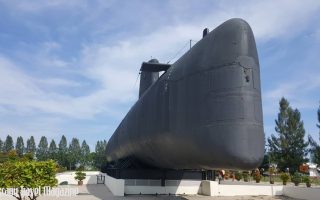
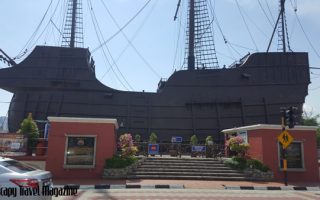
Malacca used to be a very important maritime hub and thus maritime museums are a must visit. The Submarine Museum in Malacca gives one the opportunity to see what the inside of an old submarine looks and feels like.
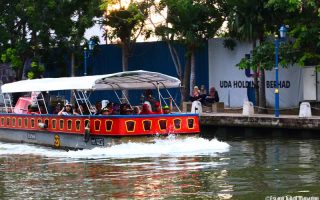
A cruise on the Melaka River is a relaxing experience. Melaka River snakes through a part of Malacca’s historical city making it a relaxing way to enjoy the sights.
Directed by Wang Chaoge, the more well known for the opening ceremony of the 2008 Olympic Games in Beijing (co-director); Encore Melaka tells a story about Malacca and its history as well as a story of its people.