Some ships are built to carry cargo. Some are built to carry cannons and warriors. And then there are ships like Frol de la Mar, which looked at ordinary history, and decided to become one of the greatest maritime legends ever to sail across the Indian Ocean.
Hang on there a minute… Did I type Frol instead on Flor? Yes, and I did so deliberately. But why?
Almost everyone today knows the carrack that Alfonso de Albuquerque sailed in as Flor de la Mar, or the Flower of the Sea. It sounds wonderfully poetic, gentle, and romantic. Like something that should be drifting through calm blue waters with dolphins performing synchronized swimming beside it.
History, however, has a habit of ruining perfectly good assumptions. The earliest Portuguese records from the sixteenth and seventeenth centuries consistently called the ship Frol de la Mar, not Flor de la Mar. Yes, Frol. That tiny difference of one letter changes everything.
Let’s board the Frol de la Mar, a beautiful Portuguese carrack.
Here is a snippet from an old book that contained the letters of Alfonso de Albuquerque, or rather, Affonso de Albuquerque; his named spelled correctly. That book is Cartas De Affonso de Albuquerque, circa 1512. Written in page 45…
‘no tempo que vim de malaca, jo cheguey a cochym, me veyo hila carta de choromamdell de quatro marynheiros que escaparam de frol de la mar e foram tel ao porto de pacee, a que nos chamamos camatora, e deste porto se passaram em hua nao de choromamdell e vieram ter a rraly,…’
The above translates (loosely) to…
In the time that I came from Malacca, I arrived at Cochym, I received a letter from Choromandell about four sailors who escaped from Frol de la Mar and went to the port of Pacea, which we call Camatora, and from this port they traveled in a Choromandell ship and came to Rraly,
*Frol de la Mar is mention in pages 45, 58, 66, 67, 117, 123, 397, 404, 406 of the book.
The Frol de la Mar is also mention in Tomé Pires’s book, Suma Oriental, back in 1515. He mentioned Frol de la Mar in pages IXXIX, 144, and 146. Page 146 talks about the sinking of the Frol de la Mar in a storm, wrecked on some shoals, with great loss of life, and of all the treasures brought from Malacca.
There are numerous other literature that mentions the the Frol de la Mar, as the ship that Affonso de Albuquerque sailed in on his conquests. And also the ship that sank due to the storm, incurring the loss of many sailors, and treasures.
So, what is frol? According to old Portuguese dictionaries, frol is an ancient form of flor, but it also carries another beautiful maritime meaning. It refers to the foam or froth upon the sea, the white spray dancing across the tops of waves when the wind is blowing just right.
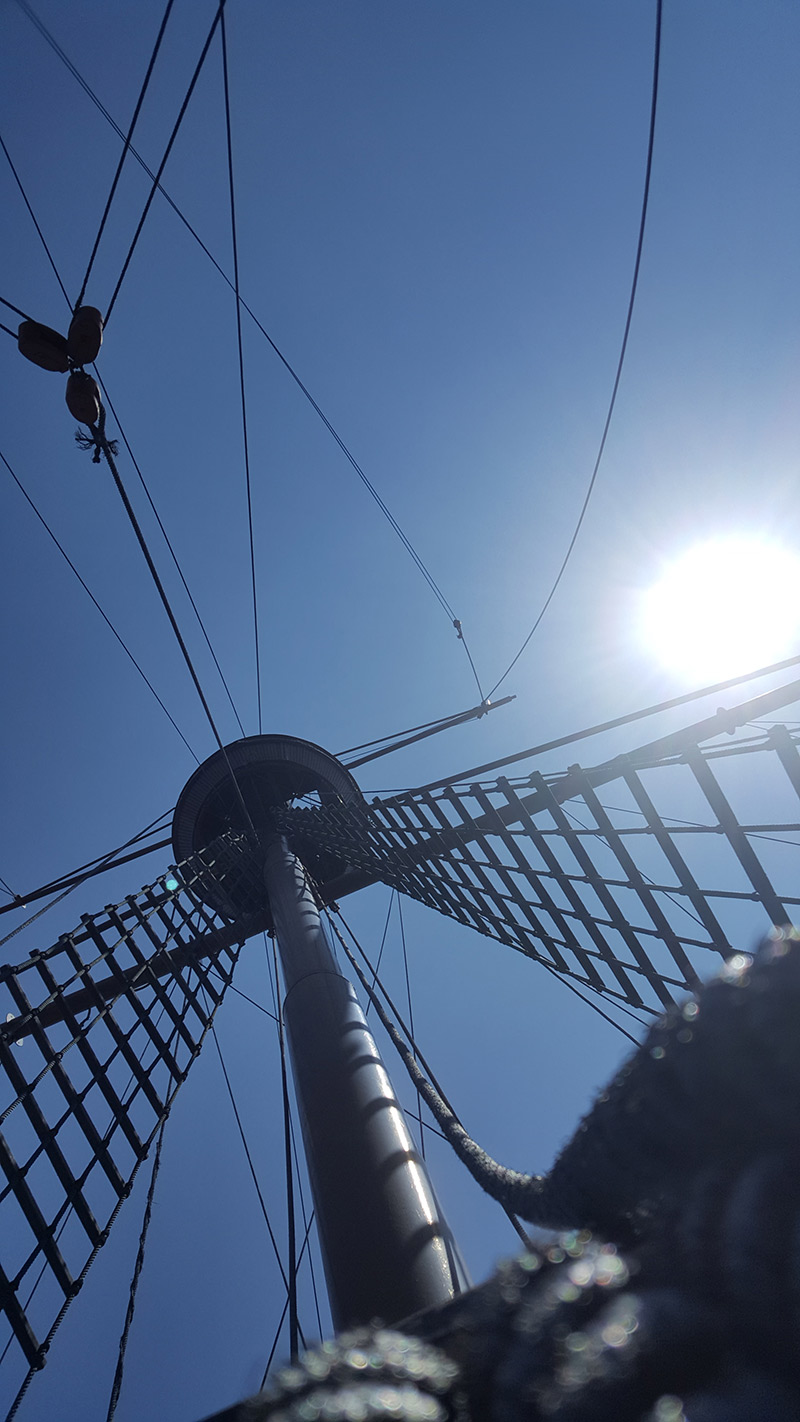
The mast of the Frol de la Mar.
With these pieces of information, suddenly, the ship is no longer a delicate flower. It becomes the froth racing across the ocean. That sounds considerably more adventurous. Old poetry even celebrates this image.
“Foamy-necked ship o’er the froth of the sea.” Now that sounds like a vessel with somewhere important to be.
The French even have the expression écume de mer, meaning “foam of the sea”, a phrase often associated with legendary sailing ships and maritime tradition. Perhaps the old Portuguese sailors understood something modern translations have quietly overlooked. Perhaps, maybe?
The story begins in Lisbon, where Frol de la Mar was launched towards the end of 1501. She was one of Portugal’s largest and most ambitious carracks, built during an age when Europe was determined to discover just how much of the world could be reached simply by refusing to stop sailing.
Her maiden voyage began in 1502, heading east toward India. Imagine the excitement.
Europe was still trying to figure out this astonishing sea route around Africa. Every voyage was part exploration, part commerce, and part gigantic gamble against storms, reefs, disease, pirates and the simple possibility of disappearing forever beyond the horizon. However, Frol survived. Not only survived, but became one of the great workhorses of the Portuguese Empire.
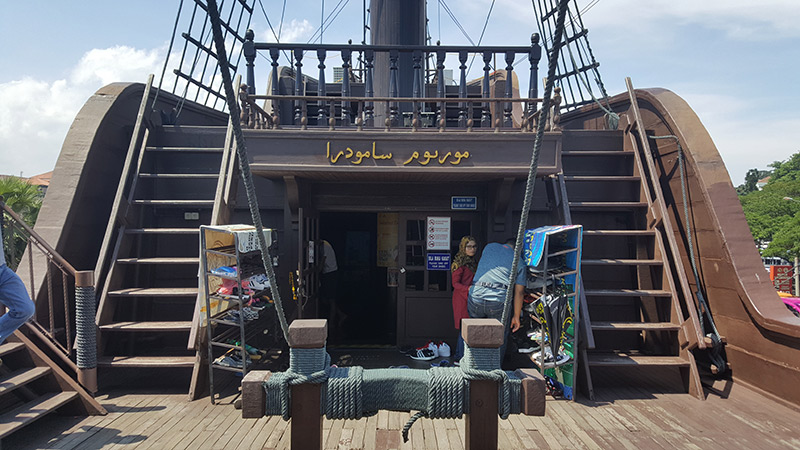
Onboard the Frol de la Mar.
Then came Affonso de Albuquerque. If the Age of Discovery had generals, Albuquerque was one of its most formidable. In 1511, Frol de la Mar sailed with his fleet to Melaka, then the richest trading port in Southeast Asia. Whoever controlled Melaka controlled one of the world’s busiest maritime crossroads.
The campaign changed history. After fierce fighting, Melaka fell into Portuguese hands. Now, trade routes shifted, empires paid attention, and the world became just a little smaller. And somewhere in all that smoke, cannon fire and triumph, floated Frol de la Mar.
If only ships could talk. One suspects she would have had stories capable of silencing an entire classroom. But every great legend needs one final dramatic chapter. In 1512, Albuquerque loaded the ship with an extraordinary cargo of treasures, royal gifts, and numerous spoils of victory; Objects of enormous value gathered from Melaka. It was enough wealth to make any pirate faint with happiness.
The voyage home started, but it never made it to its planned destination. Off the coast of Sumatra, violent weather struck. The mighty carrack, already known for being difficult to handle when heavily loaded, fought the sea, and the sea won.
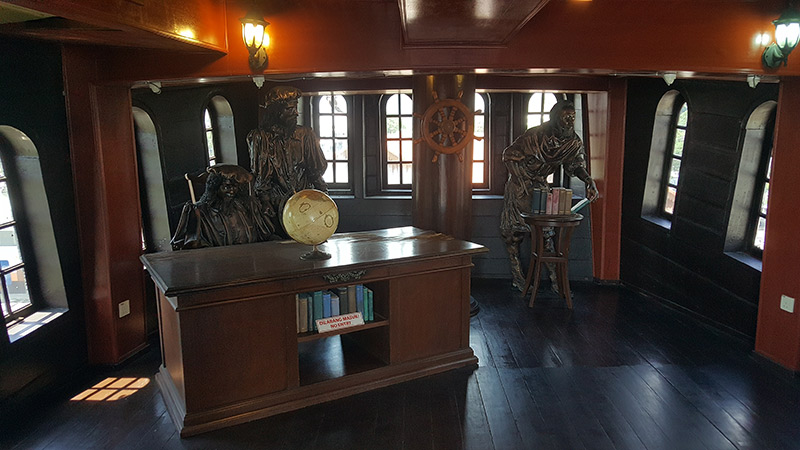
The Commander of the Portuguese army in his office… Afonso de Albuquerque perhaps.
Frol de la Mar disappeared beneath the waves, taking much of her priceless cargo with her. Albuquerque survived, but the treasure did not. Nor did the ship that had crossed oceans, carried armies, witnessed the conquest of Melaka, and earned a permanent place in maritime history. The Frol de la Mar became one of the most famous shipwrecks of the Age of Discovery.
Even today, more than five centuries later, historians, divers, and treasure hunters continue to wonder exactly where she rests, although there are claims that Tomjano, the son-in-law of a local king back then, called King Aru, found the ship somewhere off the waters of Sumatra, and brought it in. And he recovered everything that water did not spoil, making him very rich. (Tomé Pires’s book, Suma Oriental)
That said, numerous searches have been carried out, yet no confirmed discovery has solved the mystery beyond doubt. Perhaps that is fitting. Some legends are not supposed to end with someone planting a flag on the seabed. Perhaps they are meant to remain where the waves still whisper over them.
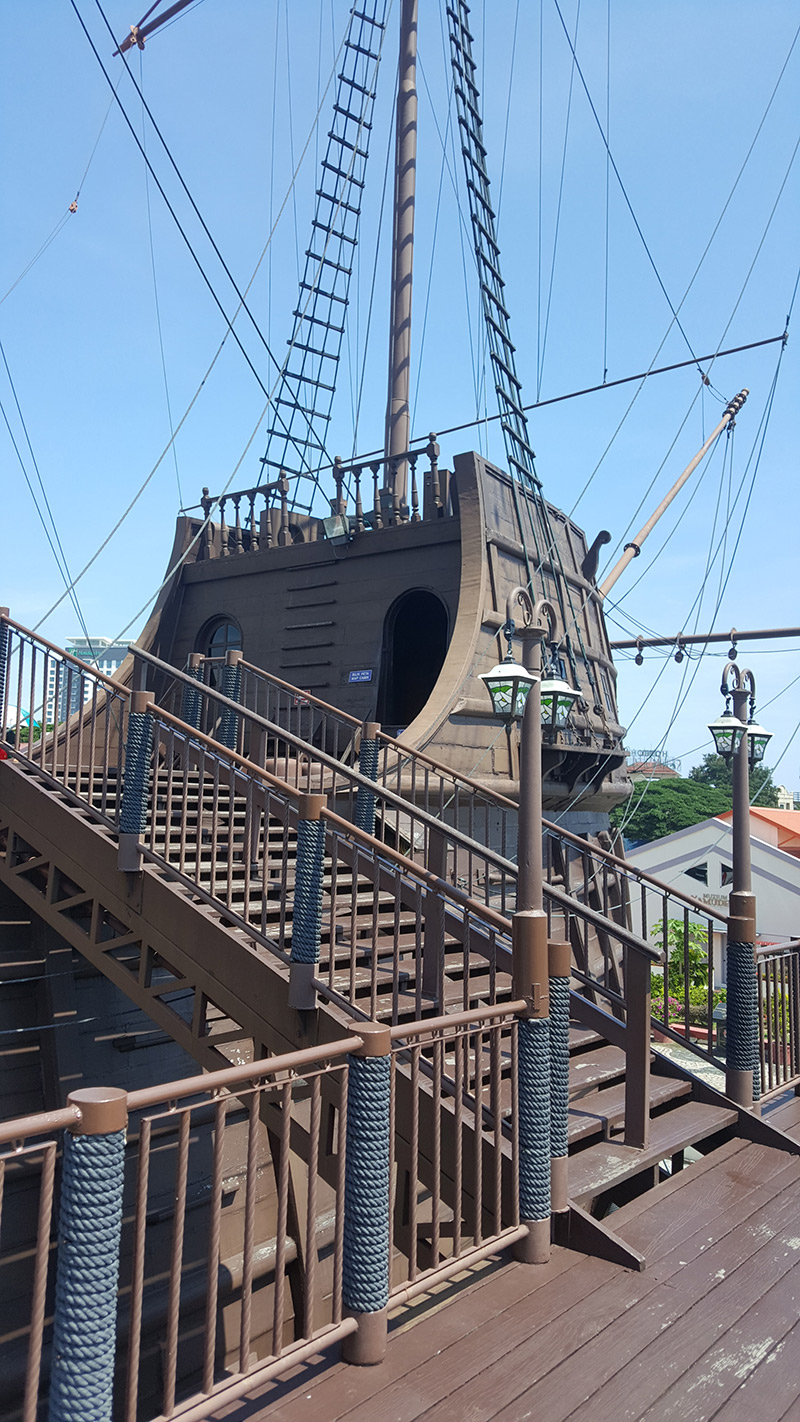
Another section of the carrack, located at the stern.
Ok, how then did the Frol de la Mar become Flor de la Mar? Now, that is one question still bugging me, and one worth digging about more for answers. Could it be a name lost in translation? Could it simply be old Portuguese vs new Portuguese language? Later writings certainly mention Flor de la Mar, wiping away the name that that great Portuguese carrack was first christened. Could it be an author’s mistake, and suddenly it is now known as the “Flower of the Sea”?
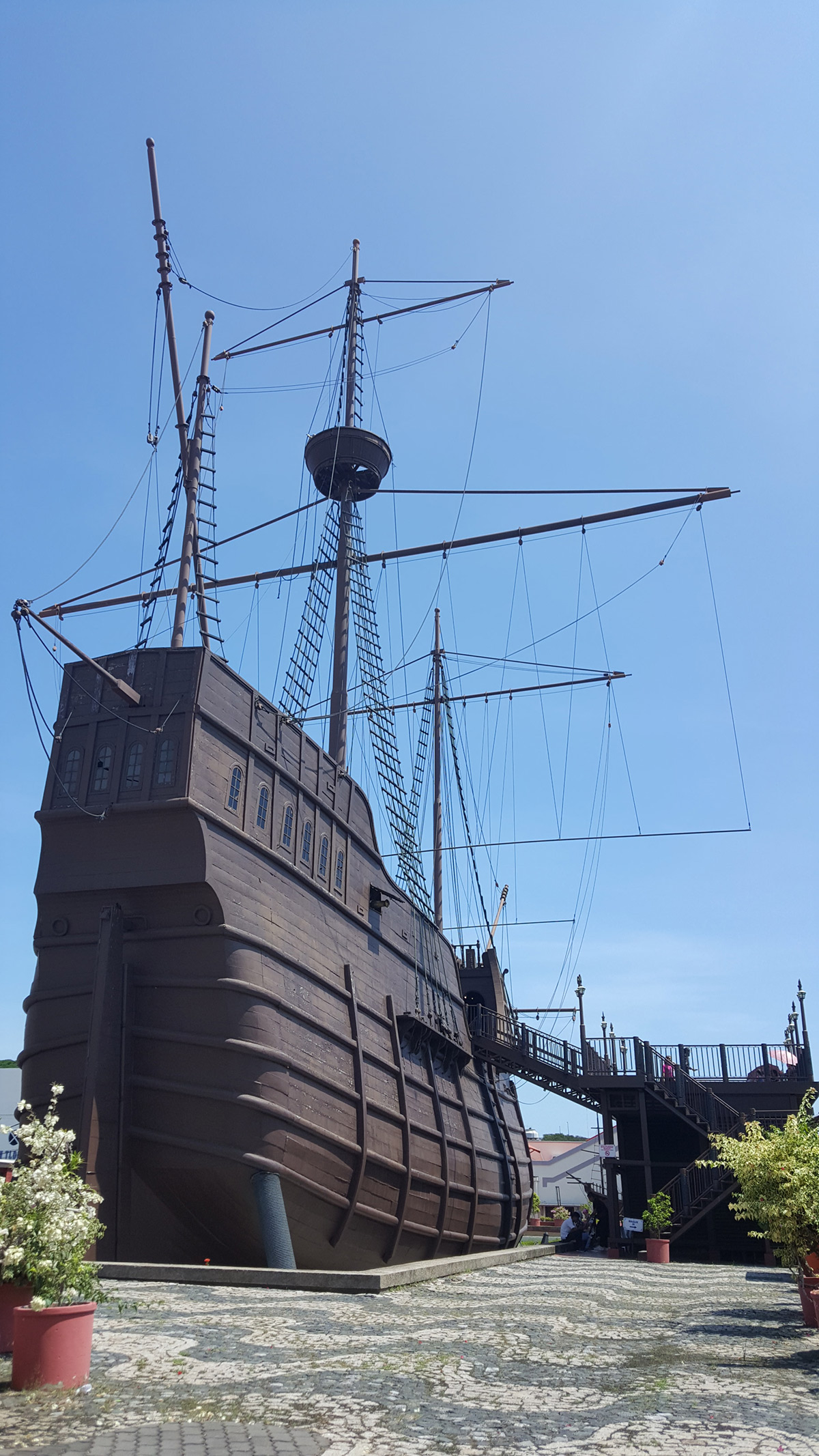
So the next time you stand beside the replica of the ship, the Flor de la Mar, or rather the Frol de la Mar in Melaka, and admire its towering wooden hull, remember that it represents far more than an old Portuguese vessel. It represents ambition, courage, commerce, conquest, mystery, and perhaps one tiny spelling lesson. Because getting her name right is important.
She lived barely a decade. Yet in those few remarkable years, she achieved what most ships could never dream of. She crossed oceans, helped reshape Southeast Asian history, carried unimaginable riches, vanished into legend, and left historians arguing over a single letter for more than five hundred years. Not bad for a ship that began life as nothing more than foam upon the sea.
Note: I have got an interest in history. But one person I want to credit this search for answers to is Historian, Serge Jardin. He has over the years pointed out the many errors made by those who are given the responsibility to uphold history, and to keep history intact.