ADVENTURES
The Baba Nyonya Heritage Museum
Where History Hides Deep Meanings
By Philemon Foo | Escapy Travel
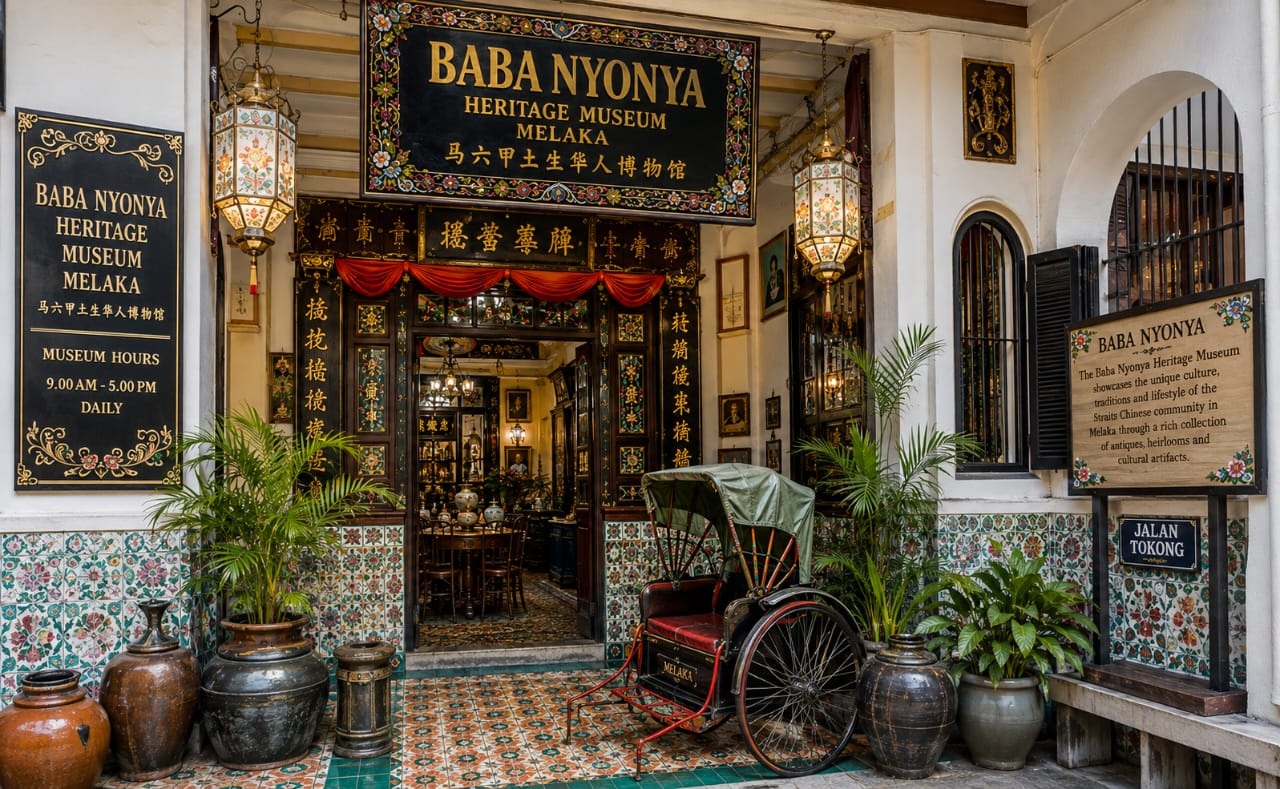
The Baba Nyonya Heritage Museum Melaka (this photo is AI generated as our photos are no longer available)
There are houses, and there are beautiful houses. And then there are houses that make you want to walk through the front door, look around and immediately announce, “everyone needs to see this.” The Baba & Nyonya Heritage Museum in Melaka is one of those houses.
Located at 48 and 50, Jalan Tun Tan Cheng Lock, just a short stroll from Jonker Walk, the Baba & Nyonya Heritage Museum is not merely a museum containing old furniture. It is an actual family home. And this is where things become rather fascinating.
The house consists of three adjoining terrace lots acquired by the Chan family in 1861. Yes, 1861. That is long before someone invented the phrase “Let’s renovate the place, and make it, errr… What do we call this? Ah, open-plan.”

Four generations of the Chan family lived here before the house was opened to the public as a museum in March 1985. The museum remains managed by the family, with descendants now into the seventh generation.
Think about that for a moment. When you walk through the rooms, you are not wandering around an anonymous historical building assembled from bits and pieces found at auctions. You are walking through a home. A home where people were born, got married, and had kids. A home where these children misbehaved, and got disciplined in the old ways. A home where families argued, made up, and life went on as normal. A home where meals were eaten with stories of the day shared. A home where celebrations took place. And a home where generations of family life quietly accumulated in the furniture, photographs, decorations, and architecture.
Suddenly, that rather impressive antique cabinet in the corner becomes considerably more interesting. Someone actually used it, and it has much deeper meaning now than when you first noticed it. History is much more entertaining when you remember that actual people had to live through it.
Welcome to the World of the Peranakans
The word “Peranakan” is often thrown around rather casually, usually somewhere between a plate of Nyonya cuisine, and a discussion about beautiful kebayas. But the story is much deeper.
The museum explains that from as early as the 16th century, merchants from China, India, and Arabia travelled to the Straits Settlements, including Melaka, Penang, and Singapore, in search of trade. Some migrants married local women, creating families whose descendants developed distinctive cultural identities shaped by both their ancestral origins, and the societies in which they lived.
The museum’s story focuses specifically on a Peranakan Chinese family. And this is what makes Peranakan culture so fascinating. It is not simply one thing, but a magnificent cultural conversation.
This is where Chinese traditions meet local customs. With that food develops its own personality. Clothing evolves with a mix of creative heritage. Language adopts new words, slang, and melodies. Architecture borrows concepts from distant lands. Religion and ancestral traditions intertwine. And out of all this mixing and adapting, something entirely distinctive emerges.
It is rather like putting several very opinionated relatives around a dinner table and discovering, years later, that they have somehow created an entirely new cuisine.
Enter Baba Chan Cheng Siew
One of the central characters in this house is Chan Cheng Siew, who lived from 1865 to 1919. The museum tells us he was a planter. He initially cultivated gambier, a crop associated with medicinal uses, before moving into rubber. And rubber, as you may have guessed, was rather good to him. Very good actually.
He became wealthy, and was known locally as “Towkay Cermin Mata”, or “Big Boss with Glasses”. I already like him. Anyone who acquires a nickname involving spectacles and being the boss has clearly made an impression.
Much of the furniture in the museum dates from the period when Cheng Siew lived in the house. He remained there until his death in 1919, aged 54. So when you look at those furnishings, you are getting something wonderfully unusual. You are looking at objects that belonged to a real family and survived the passage of time. The house becomes a kind of time capsule. Except it is a very glamorous time capsule.
And then there was Mak Gemuk, Cheng Siew’s wife; Chee Gee Geok Neo, who lived from 1865 to 1933. Within the family she was known as “Mak Gemuk”, or “Fat Mother”. This may sound rather alarming to modern ears until you understand that this was a family nickname. And then you realise something else. Peranakan family history is full of personalities.
These are not just names printed beneath sepia photographs. They were people with relationships, habits, reputations, careers, marriages, and complicated family arrangements.
Cheng Siew had three concubines. The eldest, Choo Way Neo, known as Nenek Cho, who remained in the house until her death in 1970. Suddenly, you realize that the museum visit becomes less like looking at furniture and more like discovering an exceptionally elaborate family drama. Because one thing that never changes in human history is that families have opinions.
The house Tells the story
One of the pleasures of visiting the museum is discovering the different spaces within the home. There is the main reception area, known as the Thia Besair. There is the Thia Gelap, or dark room. There is the Chim Che, the air well. There are folding-panel staircases, a wedding chamber, dining areas and the kitchen.
There is also an ancestral hall known as the Thia Abu. And yes, there is a room devoted to entertainment. Because even historically significant families eventually needed somewhere to escape from one another.
Mahjong and Cherki were among the games enjoyed by Nyonya women. The museum notes that Joo Suan, Seng Kee’s wife, particularly enjoyed mahjong and would take a trishaw to her mother’s home on Tengkera Street to play with relatives.
This tiny detail is wonderful. Suddenly the history becomes human when you let your imagination take on the script of the drama unfolding within these walls… Imagine her climbing into the trishaw, heading off to see the family, ready for an afternoon of mahjong.
The streets with people hanging about, chatting loudly, getting into other people’s business. Children running about, shouting, and simply having a blast of a time. And then a single slipper flying through the air, landing on a running child, trying to avoid doing homework.
Sometimes history is not just about wars, treaties, and conquering lands. A woman going to her mother’s house to play mahjong, taking in the scenes of the time, can be rather astonishing for history books… Well, maybe not history books, but significantly fun nonetheless.
Then comes the wedding… If you have ever thought modern weddings were complicated, the Peranakan wedding traditions displayed here may cause you to reconsider. The museum explores the Cheo Thau wedding ceremony and the elaborate traditions associated with marriage.
Peranakan weddings could be lengthy affairs, involving matchmaking, ritual, clothing, food, music, and family expectations. This was not a case of turning up at a registry office, signing something, and going out for a celebratory meal.
This was an event. A proper event. The sort of event that probably required spreadsheets long before spreadsheets were invented. And the bride’s clothing alone could be extraordinarily elaborate.
Young Nyonya women traditionally wore the baju kebaya with a sarong, accompanied by jewellery such as kerosang, and decorative hair ornaments. Older women, known as bibik, could wear the baju panjang. The result is one of the most recognisable expressions of Peranakan identity that is elegant, detailed, beautiful, and absolutely not something you would want or dare to spill curry on.
A Room of Prayer and Worship
Then you enter the ancestral hall and the mood changes. The museum explains that Peranakan-Chinese religious life could incorporate Taoism, Buddhism, and ancestral worship.
The ancestral hall at the museum remains significant to the family, and prayers are still conducted there seven times a year, including occasions such as ancestors’ birthdays, death anniversaries, All Souls’ Day, Chinese New Year, and the Hungry Ghost Festival.
That is extraordinary, because it means this isn’t simply a room preserved for tourists. It has deep meaning. It where a room that connects all the generations together, remembering the significance of every generation that made the family what they are today. That perhaps is the most powerful thing about the entire museum.
Then history gets rather serious… It would be easy to imagine that the Peranakan world was permanently filled with beautiful furniture, elaborate clothing, extravagant weddings, and people playing mahjong. But it wasn’t. History has a habit of arriving uninvited.
The museum’s account of the interwar period, from 1918 to 1941, describes a Malaya prospering through rubber, and a Peranakan community in which some families enjoyed considerable wealth and an opulent lifestyle.
Then came the Second World War. Japan invaded Malaya in December 1941. Within weeks, the old world was being dismantled.
The museum records how the Chan family’s seaside home became a farm during the Japanese occupation. Family members planted crops, caught fish, and prawns, and adapted to circumstances that were unimaginably different from their previous lives.
The family survived by changing the way it lived, and that tells us something important; culture survives because people adapt.
A museum that is Very Much Alive
This is why the Baba & Nyonya Heritage Museum is so much more interesting than a collection of pretty antiques. Yes, there are beautiful objects. Yes, the architecture is fascinating, and I love architecture. Yes, the furniture is extraordinary. Yes, you will probably take approximately 900 photographs of doors, tiles, cabinets, staircases, and things you cannot identify but desperately want to buy; if you were we.
But underneath all of that is a family story. A story about migration, hardship, trade, wealth, marriage, a mix of cultures, birth of identity, the disruptions of war, survival, and about remembering that every person has a very long past, and an incredible story.
The museum describes its vision as bridging communities to Malaysia’s history through Peranakan identity and culture, preserving the house so that its heritage can continue for future generations.
That is a rather wonderful mission, because heritage is not particularly useful if it sits quietly in a cupboard and waits for somebody to dust it. Heritage needs to be experienced, walked through, questioned, photographed, discussed, and occasionally admired while wondering how on earth anyone managed to keep such a house clean.
Go for the House, Stay for the Story
The Baba & Nyonya Heritage Museum sits in Melaka’s historic UNESCO area on Jalan Tun Tan Cheng Lock, just one street from Jonker Walk. It is easily reached on foot from the Jonker Walk area, making it a natural stop while exploring the old city.
But don’t rush it. This isn’t the sort of place where you should run in, photograph the staircase, declare “very nice” and leave.
Observe the emotions of the portraits, and feel what they share. Admire the work put into the making and caring for the furniture, made in a time where quality, workmanship, attention to detail held top priority.
Study the architecture, the language of design back in the day. Without them, Melaka would be rather square, and boring. Look at the little details of every design language, and just imagine the thought processes that ran through the minds of the architects, and designers back then.
And of course, think about the people who once occupied these rooms… a child running through the house, a bride preparing for marriage, a mother watching over her family, a businessman returning home after a hard days work, a group of women settling down for mahjong, a family gathering before an altar… That is the magic of the Baba Nyonya Museum.
You enter expecting a museum. You leave having not only meeting a family, but for a moment in time, living with the family, and embracing the heritage, and culture that the family holds. And somewhere between the antique furniture, the kebaya, the mahjong tiles, and the ancestral portraits, you begin to understand that history isn’t really only about the past. History is what made a part of Melaka’s story.
Thankfully, there are people who cared enough to preserve their history, heritage, traditions, and culture. Because without them, we’d just be looking at an old house. Instead, we now know an integral part of Melaka’s story. And what a story it is.
Additional Information
Baba Nyonya Heritage Museum
Address: 48-50, Jalan Tun Tan Cheng Lock, 75200 Melaka, Malaysia.
Contact: +6062821273
Opens daily except Tuesdays: 10:00 am – 4:45 pm

Google Maps to Baba Nyonya Heritage Museum Melaka.